Library Corner 9-8-2015

Library corner imagePilot schemes to give all children automatic library membership (BBC)

British Library rejects Taliban trove fearing terror laws (Yahoo News)

Hoopla digital Adds New Titles from Image Comics (Including the Walking Dead) (Hoopla)

School and Library Spotlight: How Schools Buy and Use E-Books (Publishers Weekly)

Public Libraries Want You to Read Local (The Digital Reader)

Slides From a Recent Conference Presentation About the American Archive of Public Broadcasting Now Online (Infodocket)

Streetlib Now Distributes eBooks to OverDrive’s 33,000 Libraries (The Digital Reader)

DPLA Welcomes Four New Service Hubs to Our Growing Network (DPLA)

Hidden Cornell treasures to be digitized (Cornell Chronicles)

Milestones: UK Medical Heritage Library Digitization Reaches Halfway Point With Over 26,000 Titles, Nearly 8 Million Page Images (Infodocket)

Worldreader and Opera Bring Books to 5 Million Readers in Africa via Mobile Phones (The Digital Reader)

Digital Collections:

Data: Statistics: State Alcohol-Impaired-Driving Estimates 2013 (Traffic Safety Facts) (Infodocket)

University Libraries Officially Open the Digital Ozark Folksong Collection (University of Arkansas)

American Physical Society (APS) Begins Adding U.S. Dept. of Energy-Funded Research Articles to CHORUS Database (Infodocket)

HN and Omaha Public Library create ‘Download Nebraska’; The Good Life premieres new video (Hear Nebraska)

Cool! The Wonderful “Old Maps Online” Database Now Has a Mobile App for iOS and Android (Infodocket)

Report and Data: Texas A&M Transportation Institute and Inrix Release 2015 Urban Mobility Study (Traffic and Commuting in U.S., UK, and Europe) (Infodocket)

Reference: Statistics: CDC Releases New Data on Vaccination Rates For Infants and Children (19-35 Months) (Infodocket)

Special Collections: “LGBT Archive at USC Preserves Personal Stories From a Hidden Past (Infodocket)

About once a week, I post links to digital-related library news articles and information about digital collections available online.  I also post other links of interest about the digital life daily on the Google Plus eBook Evangelist Page.

Did we really win the e-book debate?

award-smallThis week, the Guardian published an article by Anna Baddeley definitively declaring the reading public the winners in the digital debate.

E versus P. Digital versus paper. That, for Baddeley, is evidently the essence of the digital debate. According to her, readers have now “won” and we get move on to other issues:

More serious questions about the book industry now have space to be aired. Are we publishing too many books? Why are the authors whose books make it into bookshops overwhelmingly white and middle-class? Is there a crisis of mediocrity in nonfiction? Is the hardback/paperback cycle outmoded?

Huh? To reduce the digital debate down to simply digital versus paper is a vast oversimplification and totally ignores a large number of important issues that readers struggle with every day.

In her piece, Baddeley describes the e-book debate of three and a half years ago and concludes:

The answers tended to be very black and white. You were either an ebook zealot or a luddite refusenik.

I started this blog around the same time (January 2011) and agree, at that time, E versus P was a huge part of the dialogue about digital books. But even then, the digital debate was about so much more than e-book versus print and it had been for a long, long time. While Amazon may have had the first commercially successful ereader with its first generation Kindle in 2007, it was by no means the first e-book reader. According to Wikipedia:

There have been several generations of dedicated hardware e-readers. The Rocket eBook[42] and several others were introduced around 1998, but did not gain widespread acceptance. The establishment of the E Ink Corporation in 1997 led to the development of electronic paper, a technology which allows a display screen to reflect light like ordinary paper without the need for a backlight; electronic paper was incorporated first into the Sony Librie (released in 2004) and Sony Reader (2006), followed by the Amazon Kindle, a device which, upon its release in 2007, sold out within five hours.

Even at that time, other issues affected digital readers. Pricing was also a big issue. Back in 2008, the Dear Author blog had a post on how publishers were trying to price e-books the same as hardcovers.  The digital bookstore in question was the now defunct Fictionwise, not Amazon,  and the article mentions very high prices from Avon, Macmillan and Penguin as well.  Some of these were priced at twice the cost of the paper versions.This was long before publishing’s 2009 collusion with Apple, or the 2010 kerfluffle with Macmillan over buy buttons and pricing.

The same 2008 Dear Author post also talks about the issue of Digital Right Management (DRM) and the problems that this created for readers of e-books. The post implies that publishers at the time were blaming high ebook prices on having to incorporate DRM for various formats:

It is true that margins in ebooks are not as great as one might perceive what with Hydra of Lake DRM. In other words, because of the many formats that exist, publishers have to spend $$ to convert into each format which raises the overhead and reduces the ebook margin. I don’t feel sorry for publishers because this cost could easily be eliminated with say, excision of DRM. What an idea, right? And no, I don’t want to hear about the dangers of piracy because guess what? E publishers sell their books with no DRM and still manage to make money.

There were quite even more digital issues coming to a crisis point.  Windowing, the practice of releasing an e-book version months after the hardcover. You can read the publishers’ justification here and the reader take on the issue here.  When Harper Collins decided in early 2011 to limit library e-books to only 26 checkouts before a new copy had to be purchased, there was an uproar and a boycott by both librarians and customers.

Back in 2011,  I wrote an article for this blog on the discussion that were taking place about an ebook bill of rights.  Most of the issues talked about are still issues the digital reader has to contend with.

For example, we still do not have the freedom to buy, sell or lend ebooks that we have bought and paid for. All the shopping buttons still say buy now, not license now.

We still can’t freely transfer an e-book to another device. And no, Kindle, Nook and Kobo app being available on every device is not quite what we had in mind.) Try transferring a book  from your Kindle to a Nook or a Kobo without using a thrid party application like Calibre .

DRM is mostly still there. A few small publishing houses release books without it. Amazon gives authors the option not to add DRM and Smashwords doesn’t add it at all. For other publishers,  the face of it may be changing to other types like watermarks, but for now  it is still there on many books. For some readers and privacy advocates, it is more of an activist issue than ever.

In the area of fair pricing, many ebooks sell for as much as their paper counterparts. With the return to agency pricing in 2014, most traditionally published books are higher, especially for new releases. (See my last blog post about that one….)

Library pricing practices for ebooks may very well be worse than it was in 2011 when the Harper Collins boycott was under way. Recently, the Toronto Public Library city librarian called e-book pricing “unsustainable,” then went on to say:

According to information provided by the library, the Big Five, large publishers that provide about half the library’s books, charge libraries roughly 1.5 to five times the price average consumers pay for ebooks, and some stipulate they can be used only a certain number of times or over a certain period.

The highest prices come from Random House Canada and Hachette Book Group, which charge up to $85 and $135 per book, respectively.

HarperCollins Canada appears to have the strictest usage restrictions, allowing a book to be used only 26 times. Penguin Group and Simon & Schuster make libraries repurchase the titles after a year.

That is a big, big  jump from even the $13.99 that I personally think is too much to pay.

So, have we won the digital debate? It may well be that publishers boil the argument down to P versus E, but I think that the rest of us don’t. While we may have solved the debate over whether or not ebooks will cause the downfall of literary civilization and while many more books are available in e-book form, we are a long way from winning here. Forgive me if I don’t start the victory party just yet, okay?

What about you? As a reader, do you feel like you have won the digital debate? Or do you have issues you think still need to be resolved? Leave me a comment and let me know what you think!

Library Corner 9-1-2015

Library corner imageKids get Chromebooks, buses get Wi-Fi and school districts get technical (Times Reporter)

Two Engineers From OCLC Research Take a Look Inside the “Library Knowledge Vault” (Infodocket)

North Carolina Editorial: New libraries cannot be casualties of Senate tax game (Winston-Salem Journal)

Music goes digital at State Library as local musicians perform live for new online archive (ABC.net Australia)

Paterson schools preparing to open with fewer librarians (NorthJersey.com)

This is the end of the library as we know it (Quartz)

Why Librarians Don’t Want to Buy Your Self-Published Book (Wrapped Up In Books)

Amigos eShelf Lets Libraries Host, Check Out eBooks (The Digital Reader)

Digital Collections:

New Interactive Map & Data Tool From CDC: Antibiotic Resistance in Humans For Bacteria Transmitted Commonly Through Food (Infodocket)

Audio files: LGBTQ+ oral histories live on in new digital archive (U of Toronto Mississauga)

USDA’s National Agricultural Library Launches New Historical Dietary Guidance Digital Collection (USDA Blog)

Expanded Digitization of Islamic Manuscripts (Princeton)

New! GPO & National Archives Make eCFR Available For Bulk Download in XML Format (Infodocket)

Welcome the Texas State University to the Flickr Commons! (Flickr)

New Census Data:

New Data Files Online: U.S. Census Releases More 2012 “Statistics of U.S. Businesses” Data (Infodocket)

U.S. Census Releases Report and Dataset on Commuting to Work by Car (Infodocket)

Reference: Facts and Statistics About Hurricane Katrina (Prepared For 10th Anniversary: Aug. 29, 2015) (Infodocket)

About once a week, I post links to digital-related library news articles and information about digital collections available online.  I also post other links of interest about the digital life daily on the Google Plus eBook Evangelist Page.


Throwback Thursday: The $9.99 e-book boycott

tux-161439_1280Yesterday, I was thinking that since the e-book market has changed so much since its inception, it might be fun to do a Throwback Thursday post about e-books.

A discussion topic for  Throwback Thursday: Do you remember the $9.99 ebook boycott? Back in 2009, when e-book prices started going up, a group of Kindle owners joined together and  started boycotting e-books priced higher than the magic $9.99 mark. (You can read the story behind the boycott here.)

With the advent of agency pricing, publishers began  to set their own prices for e-books and the prices went up.  Since that time, agency has come, gone and then come back again. Now, it is not unusual to see e-books priced at $11.99 to $14.99 and up.

Personally, the $9.99 e-book boycott had a tremendous effect on me. Even today, I still refuse to pay more than $9.99 for a mere license to read a book. The truth is, I don’t really own an e-book, I can’t sell or lend it, it has no first sale rights or value, and even the transfer rights to other  devices are limited.  Convenience in purchasing, immediate gratification and the ability to change font size are not worth the trade-off. I also won’t purchase e-books that cost the same as a physical product.

To me, it is actually sad to see older backlist e-books priced nearly as high as new books:  James A. Michener’s The Source, for example, has been ranging in price from $10.89 to $12.99. The book was first published in 1965. One title presently on my watch list, Don’t Make Me Think, Revisited, is currently selling for over $20. As much as I would like to read it, I really don’t anticipate buying that one in the near future.

Since I am particular about how much I will pay for an e-book, the issue has indeed affected my book buying habits. I read a lot of indie authors who price their books at reasonable prices. I read classics from Project Gutenberg and the Internet Archive. I check out the free book listings. I watch sales, not only on Amazon, but also on Barnes and Noble and Kobo as well. I I use price watching services like eReaderIQ to track price drops. I have a subscription to Scribd that I use for backlist books that I think are priced too high. As it stands, I usually manage to read 1-2 books a week, plus re-reads and haven’t run out of material yet. 🙂

The $9.99 ebook boycott has fallen out fashion, especially among the Kindle owners who started it. Now, mentioning that e-book prices are too high on the Amazon Kindle Discussion forums is more likely to get you flamed than to see any support for the position. Ultimately, it comes down to the fact that everyone has to find a price point that they are comfortable paying. There may be some indications supporting the view that e-book sales are down due to prices.

So what about you? Do you have a cutoff price point for digital books? Have e-books prices affected your books buying habits?  Let me know in the comments.

Library Corner 8-25-2015

Library corner imageThe Rise of Phone Reading (WSJ)

Did technology kill the book or give it new life? (BBC News)

Outrage as city with new £188m library ask readers for help buying books (The Telegraph)

Are Americans falling in love with censorship? (Guardian)

Jimmy Wales Says Wikipedia Is Losing Traffic From Google (Search Engine Land)

Women’s Groups and the Rise of the Book Club (JSTOR)

Up From The Ashes, A Public Library In Sri Lanka Welcomes New Readers (NPR)

OverDrive Working on PDF Conversion, Faster Cloud-based Platform (Infodocket)

ALA Calls for an End to Mandatory Filters (The Digital Reader)

Digital Collections:

Research Tools: City of New York Launches Expanded and Enhanced City Record Online (CROL) Database, More Data and Now Searchable (Infodocket)

State library relocates genealogical collection (Daily Courier)

DataQ, a New Collaborative Platform for Answering Research Data Questions in Academic Libraries Formally Launches (Infodocket)

UO, OSU join forces to produce Web app that brings Oregon history alive (Register-Guard)

Audio Recognition App “Warblr” (Shazam For Birds) Launches in UK (Infodocket)

FOREIGN RELATIONS OF THE UNITED STATES, 1969–1976, VOLUME XXIII, ARAB-ISRAELI DISPUTE, 1969–1972 (Department of State)

Research Tools: Population Reference Bureau Releases 2015 World Population Data Sheet, Visualizations, and Interactive World Map (Infodocket)

Minneapolis Releases Archive Of Historic Images Online (CBS Minnesota – WCCO)

Update: U.S. Census Adds 2013 Data to OnTheMap Interactive Web App (Infodocket)

The New York Times Makes 17,000 Tasty Recipes Available Online: Japanese, Italian, Thai & Much More (Open Culture)

Reference: ProPublica’s Non-Profit Explorer Database Updated (990 Filings) (Infodocket)

About once a week, I post links to digital-related library news articles and information about digital collections available online.  I also post other links of interest about the digital life daily on the Google Plus eBook Evangelist Page.


Library Corner 8-20-2015

Library corner imageGoogle Maps Launches Plus Codes: “A New Way To Help Pinpoint Places on the Map” (Infodocket)

Library users reject new online catalog – old one returning (Los Altos Town Crier)

New privacy guidelines encourage libraries and vendors to work together to protect reader privacy (ALA News)

Facing Islamic State threat, Iraq digitizes national library (Associated Press)

The Library Privacy Project and TOR Project Begin Library Exit Node Pilot (Infodocket)

Crypto activists announce vision for Tor exit relay in every library (Ars Technica)

Why College Libraries Are Going Bookless (The Digital Reader)

Digital Collections:

Marx & Engels papers completely available online (Social History)

Cool! Science: NASA Makes Two New Tools About Mars Available Online (Visualizations and Simulations) (Infodocket)

Sharing a million photographs (Wikimedia Blog)

weatherView: A New Real-Time Interactive Weather Model Visualization Tool Available From NOAA (Infodocket)

Edmonton Public Library unveils music sharing site (Edmonton Journal)

Reference: New Database of Tax Exempt Organizations in New York State (Infodocket)

UW builds largest digital library of Sephardic language (Seattle Times)

Sports Reference: Full Text of the Official 2015 NFL Record and Fact Book Now Available Online (Free Download) (Infodocket)

About once a week, I post links to digital-related library news articles and information about digital collections available online.  I also post other links of interest about the digital life daily on the Google Plus eBook Evangelist Page.

Library Corner 8-14-2015

Library corner imageNYPL and Library Simplified (The Digital Reader)

Increasing Accessibility with the MARC COCKTAIL (Smithsonian Libraries)

ALA releases new digital privacy guidelines (The Digital Reader)

Libraries Taskforce secures further funding to roll out free wifi in public libraries across England (Gov.UK)

Bexar County, Texas: New Bibliotech (All Digital Library) Opens in San Antonio Public Housing Project (Infodocket)

There’s a library-shaped hole in the Internet (Boston Globe)

E-libraries transform scholarship in Myanmar (SciDevNet)

A Library in the Palm of Your Hand: Mobile Services in Top 100 University Libraries (Infodocket)

With 10,699 books printed, Windsor library’s self-publishing machine is a hit (Windsor Star)

Digital Collections:

 Open Data: Basic Metadata for the Museum of Modern Art (MOMA) Collection Now Public Domain With CC0 License (Infodocket)

Brill Launches Major New Dictionary of Ancient Greek Online (Brill)

New Database: Three NGOs Launch Fishing Transparency Website Identifying 15,264 EU Vessels Authorised to Fish Outside the EU (Infodocket)

Trafficking in Persons Report 2015 (US State Department)

The British Library and National Library of Israel Announce Partnership to Digitize Hebrew Manuscripts (Infocdoket)

William Faulkner’s Yoknapatawpha County goes online (Clarion Ledger)

New Online Database Provides Searches of Registered Designs in Israel (Infodocket)

Parker Library on the Web celebrates 10th Anniversary with a new service (Standford University Library)

Rare Elizebeth Gaskell manuscripts go digital for the first time (Infodocket)

About once a week, I post links to digital-related library news articles and information about digital collections available online.  I also post other links of interest about the digital life daily on the Google Plus eBook Evangelist Page.

Latest Kindle Fire OS Update Problems?

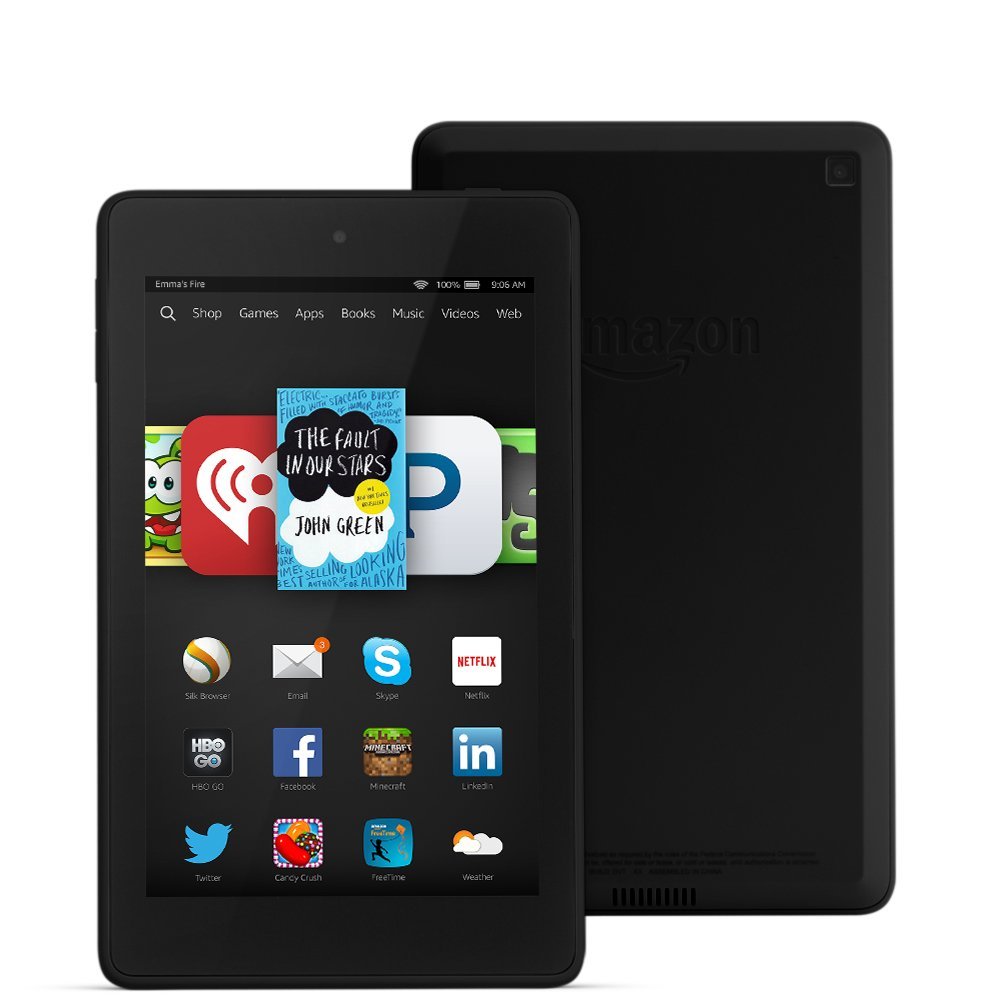
fire_6_2Over the past two weeks, Amazon has been releasing a new  operating system update for the Kindle Fire tablets. The 4.5.5 update hit my two Fire 6 tablets yesterday. One of the tablets ( my new 8GB one) was responding so slowly, I thought the tablet was defective. The drag lasted about 24 hours and then today, the device started responding normally. My 16 GB version didn’t seem to be affected at all. This updated was supposed to be for general improvements and performance enhancements.

When I looked on Amazon to see if anyone else was having a problem, I found several threads in the Kindle discussion forums (here and here) that suggested that this latest update totally bricked their Fire tablets. I hadn’t heard  of any problems on other sites like Kboards or Mobile Read.

Has anybody else had any problems?

Library Corner August 3, 2015

Library corner image8 Weird Facts From the History of the Library (Flavorwire)

APA reports continued strong audio sales (Library Journal)

U.S. Program Will Connect Public Housing Residents to Web (NY Times)

Protesters rally, check out books to make clear concerns over weeding at Berkeley Central Library (Berkeleyside)

E-books click with more library users (Asia One)

Greater Jakarta: City set to establish digital libraries (Jakarta Post)

National Archives (NARA) Asks For Public Input on Prioritizing Materials to Digitize (Infodocket)

E-book sales are flattening, but does that mean the technology is dying as consumers unplug? Financial Post)

New Report: “Who Votes? Congressional Elections and the American Electorate: 1978-2014″ (Infodocket)

Digital Collections:

Yale University’s Beinecke Rare Books & Manuscript Library Digitizing 2,000 ‘Largely Undiscovered’ Videocassettes (Beinecke)

New Video: The British Library Takes a CT Scan of Europe’s Oldest Intact Book (Infodocket)

The Georgia Folklore Collection (Digital Library of Georgia)

NASA Satellite Camera Provides “EPIC” View of Earth (NASA)

U.S. Environmental Protection Agency (EPA) releases updated environmental and public health indicators in an online database (Infodocket)

N.Y.U. Library Acquires Archive of the Digital Art Journal Triple Canopy (Arts Beat NY Times)

AP makes one million minutes of historical footage available on YouTube (Associated Press)

About once a week, I post links to digital-related library news articles and information about digital collections available online.  I also post other links of interest about the digital life on the Google Plus eBook Evangelist Page.