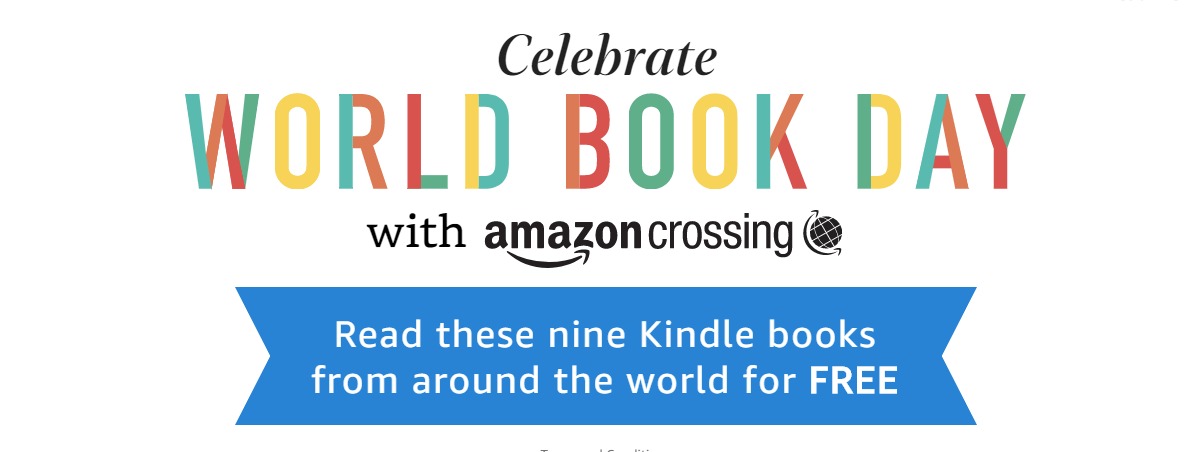
To celebrate next week’s World Book Day, Amazon is offering nine free books from their AmazonCrossing imprint. The imprint focuses on translated works and it’s stated mission is “to connect readers across cultures with books from around the world.”
The genres of the titles include a memoir, mystery, suspense, literary fiction and literary fantasy. All of the titles are English translations of award-winning books originally published in foreign languages.
The available titles are:
A River in Darkness: One Man’s Escape from North Korea by Masaji Ishikawa, translated from Japanese by Risa Kobayashi and Martin Brown: An Amazon Charts bestselling memoir about one man’s harrowing escape from the oppression of North Korea.
The House by the River by Lena Manta, translated from Greek by Gail Holst-Warhaft: An epic saga of love, adventure and family from Greece’s reigning #1 best-selling author.
Still Waters by Viveca Sten, translated from Swedish by Marlaine Delargy: The first book in the nearly 4 million-copy best-selling Swedish Sandhamn Murders series.
The Great Passage by Shion Miura, translated from Japanese by Juliet Winters Carpenter: This award-winning novel, adapted into a major motion picture, about the making of a Japanese dictionary is a reminder that a life dedicated to passion is a life well lived.
Last Train to Istanbul by Ayşe Kulin, translated from Turkish by John W. Baker: A sweeping story of love, adventure and compassion, about a young Turkish couple traversing Nazi-occupied Europe to gain their freedom, from one of Turkey’s most beloved authors.
The Gray House by Mariam Petrosyan, translated from Russian by Yuri Machkasov: An astounding and award-winning tale of a mesmerizing space where disabilities symbolize strengths.
The Question of Red by Laksmi Pamuntjak, translated from Indonesian by Laksmi Pamuntjak: A saga of love, revolution and resilience and one woman’s courage to forge her own path, from an award-winning Indonesian novelist.
The Light of the Fireflies by Paul Pen, translated from Spanish by Simon Bruni: A haunting page-turner about a boy who lives underground and discovers that light exists in even the darkest of places.
Ten Women by Marcela Serrano, translated from Spanish by Beth Fowler: A group of women with divergent life stories bond over triumphs and heartaches in this beautiful tale about universal connections from an award-winning Chilean author.
The free books promotion ends at 11:59pm PDT on April 24, 2018. Edited to add: This promotion is available only to eligible customers in the US.
AmazonCrossing books are frequently included as part of the First Reads (formerly Kindle Firsts) program and titles are available as part of the Kindle Unlimited subscription service. You can browse other AmazonCrossing titles here.
Kobo’s Daily Deal is Once We Were Brothers by Ronald H. Balson The Extra Daily Deal is Tick Tock (A Detective Shakespeare Mystery, Book #2) by J. Robert Kennedy.
(A note on Daily Deals: All prices current at the time of posting and subject to change. Most items marked Daily Deals are good for only the day posted.
Many large promotions have discount pricing that is set by the publisher. This usually means that titles can be found at a discount price across most platforms (with iTunes sometimes being the exception). If you have a favorite retailer you like to patronize, check the title on that website. There is a good chance that they will be matching the sale price.)
Daily Links are interesting links I discover as I go about my online day. The frequency and number of links posted depend upon the daily news. I also post other, different links of interest on Twitter,Facebook, and on the Google Plus eBook Evangelist Page.
Today, A look at how digital reading can offer advantages that print can’t, offering a better way to read. There’s also a look at literary translation, online security and future broadcast television standards. In deals, there ‘s savings on PNY Attache Flash drives.
Spurn the Translator at Your Own Peril (The Millions) If you read many books in translation, you know that a translator can make or break a book. This is an article about translators, written by a translator.
A Better Way to Read (The Atlantic) Critics of e-reading argue that print is better than digital. This article makes the case that digital can be better than print, especially in terms of groups that struggle with reading comprehension.
Deals of the Day:
Amazon’s selection of Kindle Daily Deals includes Dead Spots (Scarlett Bernard Book 1) from Mellissa F. Olson’s Old World Series of urban fantasies. All three of the Scarlett Bernard books are just $1.99 each. (I ♥ these!)
(A note on Daily Deals: All prices current at the time of posting and subject to change. Most items marked Daily Deals are good for only the day posted.
Many large promotions have discount pricing that is set by the publisher. This usually means that titles can be found at a discount price across most platforms (with iTunes sometimes being the exception). If you have a favorite retailer you like to patronize, check the title on that website. There is a good chance that they will be matching the sale price.)
Daily Links are interesting links I discover as I go about my online day. The frequency and number of links posted depend upon the daily news. I also post other, different links of interest on Twitter,Facebook, and on the Google Plus eBook Evangelist Page.
Wouldn’t it be wonderful to travel to a foreign country without having to worry about the nuisance of communicating in a different language?
In a recent Wall Street Journalarticle, technology policy expert Alec Ross argued that, within a decade or so, we’ll be able to communicate with one another via small earpieces with built-in microphones.
No more trying to remember your high school French when checking into a hotel in Paris. Your earpiece will automatically translate “Good evening, I have a reservation” to Bon soir, j’ai une réservation – while immediately translating the receptionist’s unintelligible babble to “I am sorry, Sir, but your credit card has been declined.”
Ross argues that because technological progress is exponential, it’s only a matter of time.
Indeed, some parents are so convinced that this technology is imminent that they’re wondering if their kids should even learn a second language.
…if the reason you are having your child learn a foreign language is so that they can communicate with someone in a different language twenty years from now – well, the relative value of that is changed, surely, by the fact that everyone is going to be walking around with live-translation apps.
Needless to say, communication is only one of the many advantages of learning another language (and I would argue that it’s not even the most important one).
Furthermore, while it’s undeniable that translation tools like Bing Translator, Babelfish or Google Translate have improved dramatically in recent years, prognosticators like Ross could be getting ahead of themselves.
As a language professor and translator, I understand the complicated nature of language’s relationship with technology and computers. In fact, language contains nuances that are impossible for computers to ever learn how to interpret.
Language rules are special
I still remember grading assignments in Spanish where someone had accidentally written that he’d sawed his parents in half, or where a student and his brother had acquired a well that was both long and pretty. Obviously, what was meant was “I saw my parents” and “my brother and I get along pretty well.” But leave it to a computer to navigate the intricacies of human languages, and there are bound to be blunders.
Even earlier this month, when asked about Twitter’s translation feature for foreign language tweets, the company’s CEO Jack Dorseyconceded that it does not happen in “real time, and the translation is not great.”
Still, anything a computer can “learn,” it will learn. And it’s safe to assume that any finite set of data (like every single work of literature ever written) will eventually make its way into the cloud.
So why not log all the rules by which languages govern themselves?
Simply put: because this is not how languages work. Even if the Florida State Senate has recently ruled that studying computer code is equivalent to learning a foreign language, the two could not be more different.
Programming is a constructed, formal language. Italian, Russian or Chinese – to name a few of the estimated 7,000 languages in the world – are natural, breathing languages which rely as much on social convention as on syntactic, phonetic or semantic rules.
Words don’t indicate meaning
As long as one is dealing with a simple written text, online translation tools will get better at replacing one “signifier” – the name Swiss linguist Ferdinand de Saussure gave to the idea that a sign’s physical form is distinct from its meaning – with another.
Or, in other words, an increase in the quantity and accuracy of the data logged into computers will make them more capable of translating “No es bueno dormir mucho” as “It’s not good to sleep too much,” instead of the faulty “Not good sleep much,” as Google Translate still does.
Replacing a word with its equivalent in the target language is actually the “easy part” of a translator’s job. But even this seems to be a daunting task for computers.
So why do programs continue to stumble on what seem like easy translations?
It’s so difficult for computers because translation doesn’t – or shouldn’t – involve simply translating words, sentences or paragraphs. Rather, it’s about translating meaning.
And in order to infer meaning from a specific utterance, humans have to interpret a multitude of elements at the same time.
Think about all the contextual clues that go into understanding an utterance: volume, pitch, situation, even your culture – all are as likely to convey as much meaning as the words you use. Certainly, a mother’s soft-spoken advice to “be careful” elicits a much different response than someone yelling “Be careful!” from the passenger’s seat of your car.
So can computers really interpret?
As the now-classic book Metaphors We Live By has shown, languages are more metaphorical than factual in nature. Language acquisition often relies on learning abstract and figurative concepts that are very hard – if not impossible – to “explain” to a computer.
Since the way we speak often has nothing to do with the reality that surrounds us, machines are – and will continue to be – puzzled by the metaphorical nature of human communications.
This is why even a promising newcomer to the translation game like the website Unbabel, which defines itself as an “AI-powered human-quality translation,” has to rely on an army of 42,000 translators around the world to fine-tune acceptable translations.
You need a human to tell the computer that “I’m seeing red” has little to do with colors, or that “I’m going to change” probably refers to your clothes and not your personality or your self.
If interpreting the intended meaning of a written word is already overwhelming for computers, imagine a world where a machine is in charge of translating what you say out loud in specific situations.
The translation paradox
Nonetheless, technology seems to be trending in that direction. Just as “intelligent personal assistants” like Siri or Alexa are getting better at understanding what you say, there is no reason to think that the future will not bring “personal assistant translators.”
But translating is an altogether different task than finding the nearest Starbucks, because machines aim for perfection and rationality, while languages – and humans – are always imperfect and irrational.
This is the paradox of computers and languages.
If machines become too sophisticated and logical, they’ll never be able to correctly interpret human speech. If they don’t, they’ll never be able to fully interpret all the elements that come into play when two humans communicate.
Therefore, we should be very wary of a device that is incapable of interpreting the world around us. If people from different cultures can offend each other without realizing it, how can we expect a machine to do better?
Will this device be able to detect sarcasm? In Spanish-speaking countries, will it know when to use “tú” or “usted” (the informal and formal personal pronouns for “you”)? Will it be able to sort through the many different forms of address used in Japanese? How will it interpret jokes, puns and other figures of speech?
Unless engineers actually find a way to breathe a soul into a computer – pardon my figurative speech – rest assured that, when it comes to conveying and interpreting meaning using a natural language, a machine will never fully take our place.
If you like to read mysteries and crime novels in general and translated titles in particular, you may enjoy today’s Kindle Daily Deal. Amazon is offer all five English translations of German author Jutta Profjit’s Morgue Drawer Series for just $1.99 each. In the opener, Pasha, the ghost of a small time car thief, inhabits Morgue Drawer Four with his body. Rather than move on into the afterlife, he is determined to solve his own murder. To do so, he joins forces with the only human who can hear him, Cologne’s uptight coroner, Dr. Martin Gänsewein.
The book was shortlisted for the Friedrich Glauser Prize, the highest crime novel prize in Germany. The series is part of the AmazonCrossing imprint which specializes in translated titles. That means this one is an Amazon exclusive.. All five books are translated by the same translator, Erik J. Macki, who, I thought, does a great job with this series. It is very readable, but still retains it sense of German identity. 🙂
One of my goals over the last two years has been to read more translated works. This series is one of my personal favorites. What about you? Do you like to read translated works?
 To celebrate next week’s World Book Day, Amazon is offering nine free books from their AmazonCrossing imprint. The imprint focuses on translated works and it’s stated mission is “to connect readers across cultures with books from around the world.”


 The eBook Evangelist