Isn’t this amazing?
Category Archives: Kitchen sink
What model Kindle do I have?
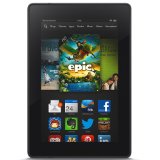 Right when they first came out, I bought one of the original 7″ Kindle Fire Tablets. I use it for games, movies, listening to music and looking up facts on IMDB. While I don’t normally like reading on it (I prefer e-ink), I do find that the full color is great for reading cookbooks.
At Christmas, I received one of the 8.9 Kindle HD Fires as a gift and now use that one for most of my movies, music and games. But I have reached the point where I own enough Kindle cookbooks that I am actually considering dedicating my original Kindle Fire for use solely as a cookbook. I actually have so many cookbooks purchased across two Amazon accounts, I am also considering buying another 7″ Kindle Fire to use as a second cookbook for the other account.
Since my intended use for the device is so specific, I don’t necessarily need the latest model, at least not for a cookbook. So, I am trying to decide whether to buy a new one, a certified refurb or a used one. And, as I am starting to research these options, I realized that trying to compare apples to apples is a little more complicated than I originally thought it would be.
The first difficultly is that people frequently use names for the Kindles that are not the official Amazon device names. For a long time, Amazon just called the latest edition of the device just the Kindle (no numbers), as if the earlier versions didn’t exist. Just look at the e-ink line: What many people call the Kindle 3, for example, is now officially called the Kindle Keyboard. And the $69 Kindle is alternately called by most people either the Kindle Basic or the Kindle 4 or Kindle 5 (there are two versions, based on a difference in color).
The model names on the Kindle Fires are especially confusing. Let’s look at just the one I am looking for: the 7″ tablet. There’s the original Kindle fire, the new Kindle Fire (which was called the Kindle Fire 2) in either 8GB or 16GB, the Kindle Fire Hd (16GB), the Kindle Fire Hd (32GB), and the 2013 Kindle Fire HD 16GB. There are also four separate versions of the Kindle Fire 8.9! The newer versions of the Kindle HD tablets are now called the HDX. And some devices are WI-FI only and others have cellular.
If you are looking at buying used on ebay, you will see that everybody uses different terms. Some use terms like “latest generation,” some have model numbers “D01400,” or “3HT7G.” Some just list 7″ wi-fi, 8GB.” One just said “Dual -core. ” Others list confusing terms like “Gen 2” and “2011.”
It became really apparent to me that some people might not know exactly what model Kindle they have.
Obviously, I want to know what model I am buying. But even if you are not in the market for a used Kindle, it can be very helpful to know what model Kindle you own. It makes a big difference with support questions; each of the different models works in different ways and has specific features. And if you want to buy a case or accessories, you HAVE to know what model you have; the cases are not interchangeable.
So, how do you find the model for your Kindle? Amazon does have a help page for identifying your Kindle model and that’s a good place to start.
If you are still not sure which one you have, you may need the model number. To find it, from your computer, log in to your Amazon account and under account, choose Manage Your Kindle. On the left sidebar, go down to Your Kindle Account and click on Manage Your Devices. You will then see all your Kindles and apps listed. The first four characters are your model number.
If you have the original box, the Amazon model number is printed on the box. You can also access the model number from the settings page of the device.
Once you have the model number, you can find out which Kindle or Fire version you have. MobileRead has a chart where you can look up the number and it will tell you which model you have. This chart does not seem to indicate the HDX models.
If the model number doesn’t help, you may be able to determine which model you have by looking at the feature list. This is particularly helpful on the Kindle Fire HD models, where the 2012 version has a micro HDMI port and the 2013 version doesn’t . And, if you have the Mayday feature on your Kindle Fire, you have the HDX!
If you still can’t find the model, you can search or post in one of the following message boards:
- Kboards (Used to be Kindleboards)
- MobileRead
- Amazon Kindle Forum
And if all else fails, you can call Kindle Support at Amazon. (Make sure you call the special support line for the Kindle. The regular Amazon customer service representatives are not trained for technical Kindle questions.)
It has been a long break, but
I am going to try to start posting on the blog again.
I apologize for the long break, but between my auto-immune disease and caring for my 83 year old mother (as well as some other life issues), the time has just not been there to write. I am hoping to try to change that.
Thanks for all your patience!
Managing your Free Kindle Books, Part One: The Problem with Free
 This is the first in a three-part series. Most of the information in this series of posts is specific to the Kindle line of e-readers and the Amazon bookstore.
A while back, I did a post on where to find free books for your Kindle. A few more are listed in this article on tips for the new Kindle Owner. When I bought my first Kindle in 2008, free books were very few and generally, offered by major publishers or their imprints. Back then, with few freebies and books going for an average of $9.99, it made sense to grab every free book that was available. And there were some good ones: I got Tess Gerritsen’s The Surgeon (the first book in the Rizzoli and Isles series) and Julia Spencer-Fleming’s In the Bleak Midwinter as just a couple of my early free books.
Now, it’s a different landscape. With Amazon’s KDP Select publishing, literally hundreds of free indie books are offered daily. The number of blogs, websites and newsletters letting you know the daily free books has multiplied exponentially. Even Amazon has made it easy with a list of the top 100 bestsellers, free and paid, on their website.
So now, the TBR pile (your stash of To-Be-Read books) has become a problem of its own.
This is where the difference between digital and physical books becomes quite clear. For a print book reader, the TBR pile was self-limiting. As some point you literally run out of room, your books fall off the nightstand, or the bookshelf simply will not hold anymore.
For book lovers, digital books didn’t have that problem. No cluttered piles of books. Promises of storage for 2000 to 3000 books on your Kindle. And, with e-readers that had expandable storage options like the first generation Kindle, you could just keep adding more and more books.
Or so it seemed. Try finding a particular book when you can’t exactly remember the name of the title. What happens when you can’t even see all your books in your archives? What happens when your battery won’t last through a book because it is constantly indexing? What if your Kindle starts to malfunction because it is too full? (And yes, that actually happens!)
So now, it seems, the problem has reversed itself: Instead of asking where do I find free books, people are asking where do I find good free books and, more importantly, how do I organize them all? Who would have ever thought that managing free books for the Kindle could actually be considered a problem?
Are you tired of sorting through lists to find free books that are actually worth your time? Maybe you are one of those people who like an uncluttered Kindle home page. Maybe you have so many books on your Kindle that you can’t find or organize them all. Maybe you are tired of books that are badly written, unedited or badly formatted. Or, perhaps, your Kindle is actually starting to slow down or malfunction because of the sheer volume of books you own.
Over the next few blog entries, we will try to address solutions to some of those problems.
Next time in Part Two: Choosing more wisely and finding sites that will help you do just that.
And in Part Three: Organizing your Digital TBR Pile. Note: Due to a family emergency, part 3 was never written.
Kindle Serials (Part Two)
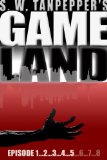
This is part two of a three part series. Part one is here.
In April, 2012, I purchased GAMELAND Episodes 1-8 for the Kindle. Designed to be an eight episode serial, the experience has proved to a lot different than what either author Saul Tanpepper or customers like myself expected it to be. Because of this, I asked him to comment on his early experiences trying to publish a serial on Amazon before Kindle Serials and his thoughts on the new program . I thought his comments were important and interesting enough to post in their entirety as a guest post.
At a press conference on Thursday to introduce the new Kindles, Amazon’s CEO Jeff Bezos announced—almost as an afterthought—that their digital publishing arm Kindle Direct Publishing (KDP), will be offering a new kind of ebook product. Kindle Serials are book-length stories delivered to customers’ Kindle reading devices over a period of time. A customer buys into the concept early, pays once, and gets future installments without having to dish out any additional cash.
I admit, I have mixed feelings hearing this.
First off, let me just say that I’m thrilled Amazon is exploring this approach. The serialized novel is not a new concept, but rather a format whose popularity has been repeatedly demonstrated throughout publishing history and which only recently had fallen into relative obscurity. What I am unhappy about is how long it took Amazon to recognize this opportunity and to offer this publishing option to authors in the first place. Six months ago would’ve been nice. A couple years, even better. After all, digital content has been delivered serially for years; and yet, for some reason, books have not been included.
It’s about time.
I approached KDP back in early April of this year (it may actually have been sooner; I can’t remember and I just can’t be bothered to wade through all my emails) with the idea of offering a book to customers as a serial. As I envisioned (and explained to them), the idea would be that customers would only have to pay once and would get a steady stream of reading material over some set future period of time. Sort of like a magazine subscription, only with books.
Sorry, they told me. Not doable.
Instead, I was told to consider using their Blogs and ePeriodicals publishing program. What is this option? Basically, anyone with a blog can deliver their content to subscribers’ Kindles when it becomes available. The caveat? It has to be published on-line. For reasons that aren’t relevant here, this wasn’t a viable option for me.
Despite this setback, I set out to publish a serialized novel anyway. Without Amazon’s blessing, I signed customers up. How could I deliver on this promise? By publishing an ebook and updating it monthly with new content. This workaround was available to me only because Amazon permits customers to receive (at no extra charge) any updates to an ebook they have already purchased. (Generally, an author might update for reasons of formatting or editing, for example.) Unfortunately, updates aren’t automatic, and customers aren’t automatically notified of their availability.
Why not?
Amazon is extremely resistant to notifying customers about updates and instead requires an author request the notification as well as to provide extensive details outlining the changes in the request. Updates, they say, must be “significant” in order to warrant a notification. The vagueness of this standard essentially means Amazon can decide to notify customers or not at its discretion.
To some degree, I understand their hesitancy. I know many authors who constantly fiddle with their books, rendering tiny changes on a regular basis. Amazon would spend a lot of time just notifying customers, and customers’ email inboxes would constantly be flooded with notices.
But there are other, more practical, reasons why updates and notifications aren’t automatic. First off, while sending electronic files is extremely cheap, it isn’t free, and Amazon foots the bill. (The initial “transfer” fee following a purchase is charged to the author in most cases, but updates aren’t).
Additionally, Amazon hasn’t yet figured out a way to update an ebook without a customer losing bookmarks, notes, and highlights. Consequently, when they notify customers of the availability of an update, or when a customer requests to receive an update, the customer must acknowledge that they understand that these things will be lost. Amazon says they’re working on this, and maybe the launch of Kindle Serials means a fix is close to being implemented.
Despite all this, I was determined to offer my urban thriller novel, GAMELAND, as a serial, and to allow customers the option of buying into the entire project early, something I had never seen before for an Amazon ebook. To incentivize customers to buy into the experiment (and because I was a relative unknown), I offered the “subscription” at a huge discount (over eighty percent off the individual episode price). What those first customers received in April, the month before the first episode was even released, was essentially a cover, a welcome note and instructions for updating the file. With each new episode, I raised the price. For latecomers, the package is still cheaper, and will always be, compared with buying the individual episodes (or even multi-episode packages).
But there has been a tradeoff for early adopters: along with the savings, they’ve had to deal with the monthly hassle of Amazon updating reluctantly and notifying sporadically. But the end of this grand experiment is now in sight, if only because there are just three episodes remaining. The launch of Kindle Serials hopefully bodes well for future projects.
Will customers buy serialized ebooks?
If GAMELAND is any indication, I think they will. My sales are still relatively small to be attempting to make grandiose generalizations, but the feedback has been nothing but positive. I can also say this with confidence: if my readers get half as excited as I do engaging in discussions about a story while it’s still being written, then they will buy into the idea of the serialized novel. Just imagine how much more popular this format will become once the obstacles are removed!
So, yes, I’m thrilled that Amazon has finally developed a process that enables authors to publish this way. But for me and my fans, it’s a bittersweet moment, the culmination of an arduous journey while simultaneously a validation that the journey itself was worthwhile. I have been blessed with readers whose enthusiasm is matched by their patience. I like to think that our struggle—and our combined and unrelenting dedication to the serial format—has finally made Amazon see the light.
In Part Three, we’ll discuss pricing and customer expectations about the serial format.
Kindle Serials (Part One)
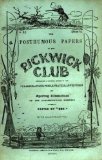 In the midst of all the announcements about Amazon.com’s new family of Kindles was an unexpected tidbit: The announcement of Kindle Serials.
Now, serials are nothing new. Dickens did them (and Amazon is giving a couple of those away for free to celebrate the new program). Many of my favorite classic sci-fi novels started as serials back in the days of the pulps. Back in 1996, Stephen King resurrected the serial form with his Green Mile series, with rival John Saul penning The Blackstone Chronicles shortly thereafter. (And, just for the record, I bought both of them….)
Tor Books recently garnered headlines by announcing that they were going to be serializing the next installment in John Scalzi’s Old Man’s War series. In reality, however, small presses and authors have already been digitally serializing books for some time now–without the credit given to Tor and now, Amazon.
Just ask Kate Sullivan, editor-in-chief and the mastermind behind Candlemark & Gleam, a small press in Bennington, Vermont. Just be prepared to duck (digitally, of course). The normally good-humored Sullivan had a few things to say about mainstream publishers taking the credit for being “unique” and “innovative” by publishing serial fiction. Candlemark & Gleam has been publishing it online for several years.
When asked about the Amazon announcement, Sullivan was more positive:
I’m choosing to look at the Kindle Serials announcement as a good thing. At Candlemark & Gleam, one of our earliest goals was to bring some classic publishing ideas back into practice; from the beginning, part of that involved working with serial fiction – one of our first titles, two years ago, was a serial. Serials were, for a very long time, a vibrant part of the publishing landscape, and also intimately connected with the world of science fiction and fantasy, which is obviously near and dear to us. Given that modern technology has made it simpler than ever to publish short works directed at a specific, interested audience, we figured that the time was right to push for serial fiction to come back. Unfortunately, since serials fell by the wayside in the latter part of the 20th century, it’s taken some doing to get people to understand what a serial even is, much less to understand the vagaries of how one might be delivered, or to buy in to the joys of delayed gratification. That’s been the biggest challenge facing our two serial projects thus far, and I think it’s a challenge that the prominence of Kindle Serials might help overcome. Say what you will, but Amazon has a lot of clout, and a lot of ability to push ideas into the mainstream. If Kindle Serials mean that more people are willing to give delayed gratification and serial stories a try, then hurrah!
What I’m most hoping for, though, is a simplification of the delivery process. Our two serials so far have been Hickey of the Beast, a YA fantasy by Isabel Kunkle, and Constellation Games, a “space opera soap opera” by Leonard Richardson. Both serialized as weekly emailed chapters initially, with Hickey of the Beast also available as an auto-updating iPhone and Android app, and both are now available in compiled form as both eBooks and paperbacks. When we were originally serializing the novels, they were pushed as emails to subscribers each week, with PDFs of each chapter available on a subscriber-only webpage. With the Kindle Serials plan, it’s possible that there will be a means for publishers and self-published authors alike to make serials available with each chapter auto-delivered to a subscriber’s Kindle device – much simpler than loading a PDF each week, and just as easy as opening an email on your smartphone. Between easing the delivery process and making readers aware of serials as a great option – just think about how much you look forward to each week’s installment of your favourite TV show! – there’s a good chance that Kindle Serials will inject some new life into a format that many of us have been struggling to revive.
I highly recommend reading Ralph Vicinanza’s fascinating introduction to the Kindle edition of The Green Mile for background on just how groundbreaking an idea it was to do a serialized print novel. If you don’t have the book, you can read the intro on the “Look Inside” feature here.
There’s so much to say about this subject that this is going to be a three part article. In Part Two, we will talk with author/publisher Saul Tanpepper about his experiences publishing his serial novel, GAMELAND on Amazon prior to the Kindle Serials program. In Part Three, we are going to look at pricing.
E-reader makes it to the dictionary…
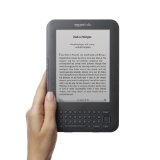 According to this article, Merriam-Webster added the word e-reader to their dictionary. Now, before you get all excited, thing about this: That also means there is now a proper and right way to spell it! No more make-up-your-own-mind choices like ereader or eReader.
Now, college professors, bosses and newspaper editors are all going to insist that the word is spelled correctly. And, horror of horrors, my blog tags and categories are no longer correct.
And here I was, hoping for a hyphen-free spelling solution….
The future of the library and the great content divide
As someone who tweets a great deal about public libraries, this article from TheDigitalShift, Ebook Strategy and Public Libraries: Slow Just Won’t Work Anymore, speaks volumes.
The article addresses many of the important issues at the heart of the library ebook problem such as Overdrive’s monopoly and publisher’s refusals to sell ebooks because of fears of the library model. But it is the following paragraph which presents a truly terrifying scenario:
The perfect storm formula of a monopolistic environment and the actions (or more accurately, the deliberate inaction) of publishers have resulted in the creation of a significant shift in public policy in this country. After more than 100 years of public libraries circulating materials to users, we are no longer able to provide access to critical content that now exists in digital form. As a result, two very distinct scenarios are emerging in the communities we serve. Affluent users in prosperous neighborhoods have universal broadband access, numerous ebook hosting devices, and a credit card with the disposable income to acquire whatever content they want. Low-income residents in poorer neighborhoods do not have this sequence of resources and run the risk of not being able to access digital content that will allow them to fairly participate, compete and contribute to the digital economy/world. This content divide goes against the very principles that attracted so many of us to this profession –supporting democracy by providing access to information in the broadest possible context.
The issues so succinctly raised in this article are ones that all of us, as a society, should be very, very concerned about.There is much more in the full article, including suggestions about how to work towards a solution. If you care about public libraries, this is a must read article!
Norway’s National Library Digital Newspaper Service
Here’s an interesting article on Norway’s National Library digital newspaper service. Seeing models like this one work is heartening, especially as we are looking towards digital models here in the US!
May 4, 2012 is International Day Against DRM
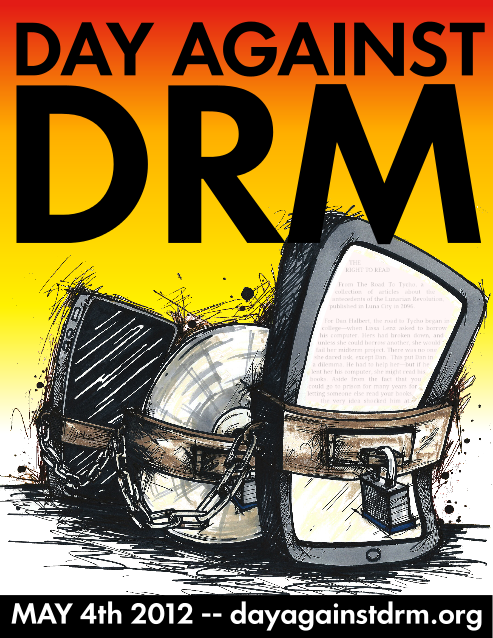 May 4th is International Day Against DRM. The day is intended to protest crippling Digital Rights Management solutions which prohibit people from freely accessing and sharing files that they have legally purchased.
While most music files are now available DRM free, it is still a huge problem in the ebook world. Publishers, are, however, beginning to take notice. Tor Books recently announced that their titles are going to be offered DRM free.
There are a number of small presses that offer their titles DRM free. Please leave a comment with the name and website of small presses that offer freely accessible files.
Learn more at http://www.defectivebydesign.org/dayagainstdrm.
 The eBook Evangelist