The future of the library and the great content divide

As someone who tweets a great deal about public libraries, this article from TheDigitalShift, Ebook Strategy and Public Libraries: Slow Just Won’t Work Anymore,  speaks volumes.

The article addresses many of the important issues at the heart of the library ebook problem such as Overdrive’s monopoly and publisher’s refusals to sell ebooks because of fears of the library model. But it is the following paragraph which presents a truly terrifying scenario:

The perfect storm formula of a monopolistic environment and the actions (or more accurately, the deliberate inaction) of publishers have resulted in the creation of a significant shift in public policy in this country. After more than 100 years of public libraries circulating materials to users, we are no longer able to provide access to critical content that now exists in digital form. As a result, two very distinct scenarios are emerging in the communities we serve. Affluent users in prosperous neighborhoods have universal broadband access, numerous ebook hosting devices, and a credit card with the disposable income to acquire whatever content they want. Low-income residents in poorer neighborhoods do not have this sequence of resources and run the risk of not being able to access digital content that will allow them to fairly participate, compete and contribute to the digital economy/world. This content divide goes against the very principles that attracted so many of us to this profession –supporting democracy by providing access to information in the broadest possible context.

The issues so succinctly raised in this article are ones that all of us, as a society, should be very, very concerned about.There is much more in the full article, including suggestions about how to work towards a solution. If you care about public libraries, this is a must read article!

Just the facts…

I just listened to an interesting podcast of the Kojo Nnadami Show on E-Books: Chosing a reading device and a bookseller.

While there were some interesting points to the broadcast, as an ebook aficionado, I found it a little disturbing that people considered experts in the field could be totally unaware of certain facts about the ebook industry.

Among the misstated facts:

  • Amazon deleted 1984 off customers’ Kindles last year. In fact, it was 2009.
  • It is unusual for someone to own more than one ereader.
  • Typos and scanning errors are no longer a problem with ebooks.
  • It seems that there is also some confusion about the program Calibre and its capabilities. Calibre can convert one ebook format to another; it does not strip DRM from ebooks. There are third-party plug-ins for the program, however, which are rumored to do that.

The broadcast does make some valid points about the ownership issues surrounding ebooks.

Is it Midnight at the Well of Souls?

Any Jack L. Chalker fans out there?

A chance conversation overheard on Twitter today referencing sentient plant life started me thinking about the Well World series and the Czill species. It also led me to a very strange description in this alien wiki that sure doesn’t jive with my recollection of the books. Time for a re-read.

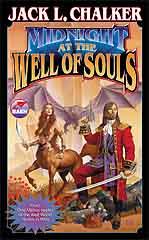
That thought, of course,  led me to search to see any of these incredible books were available as ebooks. And to my surprise, they are! Baen Books has them available, and at reasonable prices, starting with Midnight at the Well of Souls…

Have you ever read this incredible science-fiction series?

Ebooks are too real books!

Finally!

It is always great to hear someone else say exactly what you thought about a subject.

When that video about books playfully moving around on the shelves was making the rounds on the social networks, I found myself getting furious every time I saw it. It was that ending screen that said “There’s nothing quite like a real book.”

What the heck? Since when are ebooks not “real” books? Isn’t it what’s in them that counts, at least with most books?

Needless to say, this article from Urban Times called “In Defense of the eBook” made my day. Check it out and let me know what you think. Do you get upset when people say ebooks aren’t real?

Penguin Restores Access to Library Books, but…

My, how one day changes things! Penguin has restored access to Kindle versions of their ebooks, but still has concerns, including some that (surprise) need to be worked out with Amazon.  New ebook titles are still not available in OverDrive.

But now, Random House has announced that it is reviewing its own library ebook policies.

As the story evolves, Twitter users are labeling Tweets about the issue with the hashtag #penguinod.

Yesterday (Tuesday) was a day of a lot of speculation on possible reasons for Penguin’s actions. It was also a day of reactions from both librarians and patrons.

An article in the Library Journal’s Digital Shift detailed how complaints from angry patrons surprised librarians who had no advance warning that the books were being pulled. The tension between Penguin and Amazon, along with a past history of difficult negotiations is also cited in the article as a possible reason for the books’ removal from the OverDrive System.

OverDrive’s initial announcement mentioned “security concerns” with the ebooks. The Digital shift article also reported that patrons has stated that, at least in some incidences, books are remaining on the patrons’ Kindles after the lending period is over.

And from Paid Content, there’s a thoughtful article by Laura Hazard Owen that offers answers to its own questions in  Why Might a Publisher Pull Its E-Books From Libraries?

In a piece from Teleread, InfoDocket’s Gary Price points to a February 2011 letter by OverDrive CEO Steve Potash  published on Librarian by Day as a possible explanation for Penguin’s actions:

In addition, our publishing partners have expressed concerns regarding the card issuance policies and qualification of patrons who have access to OverDrive supplied digital content. Addressing these concerns will require OverDrive and our library partners to cooperate to honor geographic and territorial rights for digital book lending, as well as to review and audit policies regarding an eBook borrower’s relationship to the library (i.e. customer lives, works, attends school in service area, etc.). [EMPHASIS ADDED] I can assure you OverDrive is not interested in managing or having any say in your library policies and issues. Select publisher terms and conditions require us to work toward their comfort that the library eBook lending is in compliance with publisher requirements on these topics.

When this letter was originally written back in February during the licensing change demanded by Harper Collins, it seemed that this paragraph seemed squarely directed at concerns over libraries like The Free Library of Philadelphia.

Long before the Kindle allowed library lending, the Free Library had long been discussed on sites like Kindleboards.com and the MobileRead.com forums as a source of library ebooks. The library allowed out-of-state residents to get a library card for a fee.  Users could then use their computers and the OverDrive system to access the ebooks.

Because of its large collection, the Free Library has been very affected by loss of Penguin ebooks and is keeping its patrons updated on its blog.

This whole situation is making it confusing for consumers who have bought or were planning to buy ereaders as gifts for the holidays. The prices of Kindles have come down significantly ($79 for the entry-level e-ink,  $199 for the Kindle Fire). But many consumers have been adamant that lending and library books are an essential part of the equation.

Competitor Barnes and Noble has already announced that its Simple Touch Nook will be only $79 on Black Friday. Kobo is selling its Touch at more retail stores and plans to offer wi-fi Kobo readers for only $59. Ereaders and tablets will likely be big sellers this holiday season.

Sarah from the Smart Bitches, Trashy Books blog did a nice write-up on this whole situation yesterday and summed it up succinctly: ” Holy crap in a sidecar, you cannot make up lunacy this frustrating. I need to read a romance. STAT.”

Yeah, Sarah, save one for me. I am sure we haven’t heard the last of this….
DC Comics make publishing history

DC Comics is making publishing history by offering a Print-Digital combo pack starting with Justice League 1 on August 31, 2011.

This follows on the heels of DC’s announcement that they are renumbering all of their comics, ditching the old numbering system and rebooting so that all the series will start with number 1.

DC Comics’ new pricing strategy addresses several of the issues that eBook consumers have asked for, such as a print-digital package and digital-only pricing discounted proportionately to the print-only version. The fact that the price reduction is scheduled is also a bonus. DC will regularly reduce the price on products at four weeks; currently, ebook customers have no idea when prices will be dropped on any particular book.

Many will see this as a step forward for ebook consumers, especially if other publishers follow suit. Are you listening, Big Six?

This post composed while listening to The Complete Billie Holiday.

Authors asking for a boycott of Dorchester Press

Popular mid-list author Brian Keene has asked on his blog for a boycott of Dorchester Press (Leisure) for non-payment of royalties and publishing ebooks whose rights have reverted back to the authors. He is asking fans to:

*If you follow them on Twitter, please unfollow them.
*If you like them on Facebook, please unlike them.
*If you receive their marketing emails, please remove yourself from their list.
*If you belong to one of their book clubs, please consider canceling your membership.
*If you are considering publishing with them, please reconsider.
*Most importantly, please don’t buy their books, regardless of whether it’s on their website, in the $1.99 dump bin at Wal-Mart, or available on the Kindle.

When asked why he doesn’t hire a lawyer, he answers succinctly:

… someone asked me why we (the authors) didn’t just seek legal means. Well, I can’t speak for any of the other authors involved, but I’ll tell you why I haven’t — because I’m broke. I’m broke because Dorchester didn’t pay me what was owed, and then I gambled to get my rights back, and then they continued to fuck me. And yes, I’ve got a nice new deal with Deadite and Ghoul starts filming next month, but I won’t see checks from either of those until a few months from now, and until then, I can barely pay the rent and eat anything more than Ramen noodles, let alone hire an attorney.

Keene gives a list of authors supporting the boycott and links to a post by Robert Swartwood also asking for a boycott.

This situation is disturbing for several reasons. First, generally speaking, fans want to see authors to get paid.  That’s part of the reason that indie authors do well in the ebook market. As of today, Keene has 224 comments on his blog post and I read message after message of support.

Secondly, this highlights a concern about ebooks and digital property. There have been issues before about people publishing content they don’t have rights for. Amazon will certainly assume that a publisher (especially a well-known one) has the right to distribute an ebook for an author. 

Keene’s books happen to be on my TBR list; I don’t own them yet. And as a potential fan who wants to buy the books in an ebook format, it is extremely frustrating. I want to support the author but want to make sure that I don’t put money into the hands of a greedy publisher who would treat authors in this way.

Today Keene updated his blog with information from some other authors owed money by Dorchester.

This post composed while listening to the Ramones’ Greatest Hits.

Lendle Axed by Amazon

The Kindle lending service Lendle had its access to Amazon’s API shut off today.  Lendle has made a statement on the situation on their website, saying that:

The letter we received from Amazon states that the reason our API and Amazon Associates accounts have been revoked is that Lendle does not “serve the principal purpose of driving sales of products and services on the Amazon site.”

Lendle goes on to say:

We do know that we’re not the only eBook lending site who had their API access revoked today, so we can only speculate that it wasn’t anything about Lendle specifically that caused Amazon to act today, but rather something a bit bigger than us. We know publishers have been skittish about lending, and aren’t yet seeing how much value it brings them, so we might speculate Amazon was acting on pressure from them. [Emphasis added]

Personally, I don’t think that it is all that difficult to speculate what that pressure might be about. This is happening almost exactly a year since Macmillan boycott and the Agency Model went into effect. If, as I surmise, Amazon is once again in negotiations with publishers then lending and ebook rights are almost certainly on the agenda. That, coupled with the sudden rise of several services facilitating the loan of ebooks (with some even charging a fee for the service), does not bode well for readers’ rights in the future.

I also think that it is highly unlikely that it is a coincidence that this situation and the Harper Collins limit on libraries lending eBooks are happening at the same time. Harper Collins has been strangely silent on the library lending issue which may mean that it has some bearing on larger negotiations with retailers.

Watch this space; we are going to hear a lot more about these lending issues.

This blog entry composed while listening to American VI: Ain’t No Grave by Johnny Cash

What’s in your ebook bill of rights?

One of the big issues over this last week has been Harper Collins’ announcement that they were placing limits on how many times a library book may be circulated. The last-minute announcement broadsided librarians and readers alike. (There are roundups of the blog entries and media coverage available and  you can follow the discussion on Twitter under the hashtag #HCOD.) EDIT: Sorry, but that hashtag no longer has the same meaning and that information is no longer available.

Ironically, the new limits went into effect on March 7, 2011, right at the beginning of Read an Ebook Week.

Those discussions have yielded a lot of interesting ideas about accessibility, DRM (Digital Rights Management) and the future of ebooks. One of these ideas is the aggressive promotion of an eBook User’s Bill of Rights, most frequently the one offered by Sarah Houghton-Jan on her blog, Librarian in Black.

Sarah’s bill of rights focuses on:

  • the right to use eBooks under guidelines that favor access over proprietary limitations
  • the right to access eBooks on any technological platform, including the hardware and software the user chooses
  • the right to annotate, quote passages, print, and share eBook content within the spirit of fair use and copyright
  • the right of the first-sale doctrine extended to digital content, allowing the eBook owner the right to retain, archive, share, and re-sell purchased eBooks

Well known tech blogger Mike Cane tackled this subject as well on his own blog last August in his article the Ebook Buyer’s Bill of Rights.   His bill of rights focuses mainly on issues involving appearance and functionality: covers, table of content, bookmarks. Formatting issues are also important in his version:

3) You have the right to proper formatting by default.
a) Formatting should mirror a proper printed book.
b) Paragraphs should have indents without spaces between paragraphs.
c) Only after such proper default formatting should a reader be able to mix things up via a device’s software settings (typesize, spacing, margins — in other words, reflow overrides).

A site called the Reader’s Bill of Rights promotes rights for readers of digital books. Created by librarian Alycia Sellie and technologist Matthew Goins, the site advocates critical looks at the downsides of ereader technology and has an anti-DRM stance. The powerful graphic for Libraians against DRM shown above comes from their site. (Note that this site was registered in April 2010, well before the Harper Collins OverDrive announcement.) Its bill of rights focuses more on DRM and accessibility.

The Readers’ Bill of Rights for Digital Books:
1. Ability to retain, archive and transfer purchased materials
2. Ability to create a paper copy of the item in its entirety
3. Digital Books should be in an open format (e.g. you could read on a computer, not just a device)
4. Choice of hardware to access books (e.g. in 3 years when your device has broken, you can still read your book on other hardware)
5. Reader information will remain private (what, when and how we read will not be stored, sold or marketed)

The site also has an interesting blog entry about the ALA president speaking out about this issue on Facebook. The entry links to one of the best arguments I have ever seen for NOT joining the social networking giant.

Each of these rights statements makes it extremely clear that they are meant to be starting points for the conversation about rights. It is also quite obvious that each author has different priorities that are important to them, whether it is the first sale doctrine or DRM.

What I personally find extremely surprising, given all the discussion about eBook prices, is that none of these rights statements even mentions the concept of the price of digital books as an important factor.

How about you?  Is there something that you think should be included in an ebook bill of rights?  Is a fair price something you would like to see as part of the discussion?

Read an eBook Week is coming: March 6-12, 2011

Read an eBook Week will be starting March 6, 2011. The purpose of the week is to draw attention to and promote the reading of ebooks. This event has been an ongoing project since 2004. You can get more information by visiting the event’s website.

Here at the eBook Evangelist, I have been working on a series of articles to celebrate eBook week, including overviews of different readers, formats, software and apps,  and where to find free ebooks. Stay tuned for more!