Is Kindle Unlimited worth the price?

Amazon has introduced the Kindle Unlimited (KU for short) subscription service and it seems to have created quite a buzz.
KU_tcg_470x200._V349150858_

It offers unlimited access to over 600,000 Kindle books and over 2,000 audiobooks with Whispersync for Voice. You can keep up to ten books at a time and there are no due dates. You can read your Kindle Unlimited books on any Kindle device or any of free Kindle reading apps.

For new subscribers, there is a free 30-day trial. That also includes a free Audible membership for up to three months. The Kindle Unlimited subscription includes 3 free Audible books (even if you are already a subscriber).

  • If you like to own books
  • If you like to read bestsellers
  • If you read very few indie published books
  • If you only read a few books every month
  • If you read mostly free books or classics
  • If you mostly buy books on sale
  • You already have an Audible membership
  • If you are already a Prime member and satisfied with one free book rental per month.

In that case, Kindle Unlimited may not be a good value for you.

The answer may be yes if the following is true:

  • If you need to read on e-ink only
  • If you read mostly indie authors
  • If you read lots of short stories and short non-fiction books
  • If you want more than one book per month from KOLL
  • If you don’t have an actual Kindle or Kindle Fire device (read on app, tablet, computer or phone)
  • If you use Whispersync to switch back and forth with audio for a lot of books
  • If you do not re-read books or do not want to own every book you read.
  • If you spend a lot each month on books that are also in the KOLL Library.

But what if you find that points from both lists apply to your situation?

First, browse or search available books  to see the offerings.

Compare the list of books in the KU program to to your Wishlist or TBR (To Be Read) list.

If you already subscribe to Scribd or Oyster, compare the lists of available books on those services to see which one offers you the most value.

Lastly, tale a look at your monthly book budget, your spending history and what types of book you are reading to see if the service is cost effective.

A case study:

I am going to use myself as a case study. 🙂 Here’s the background: I am an avid reader whose reading time is more constrained than I would like. I have both e-ink Kindles and Kindle Fire tablets. I like to own books and re-read favorites. I prefer to read on e-ink versus a tablet or phone.  I am already a Prime Member and also have an Audible membership. I rarely use Whispersync. I do have an Open Library membership. I also have a membership to Scribd (a gift), although not being able to use it on an e-ink device limits its usefulness for me – I haven’t yet finished one Scribd book.

Not including re-reads, I generally read 1-2 full length books per week (fiction and non-fiction). I also read serials, short stories and short non-fiction works. Since I only read e-books any more, I am replacing my print copies of old favorites with e-books. 

I like to read a variety of books.I read almost every kind of fiction, but primarily enjoy read classics, mysteries and thrillers, SF and horror. In non-fiction, I enjoy history, and anthropology, self-help, spirituality,motivational reading and how-to books. More than half of the authors I read are indies and small press titles. Many of the short stories, non-fiction booklets and new authors I read come from trying books that are offered for free. If I like them, I then generally buy new and backlist titles of the author’s works. I refuse to pay more than $9.99 for a license to read an e-book and pay close attention to sales like the Kindle Daily Deal and price reductions for bestseller and backlist purchases. I frequently try new authors via the KOLL library, but there are months that I actually forget to borrow my free book.

I went back and looked at my book purchases for the month of June. Most of the paid books I purchased last month are NOT available as part of the Kindle Unlimited service. Two of my June purchases, Dead Spots and Trail of Dead, were originally KOLL borrows that I liked so much I went back and purchased copies to own when they were on sale. Most of the free books I picked up that month were gardening books for my container gardening project that I probably would not have gotten if they weren’t free.

I concluded that, at least for me, I probably would not have saved any money in the program. Because I already have access to most of the books already (either through KOLL or as free promotional books), I feel that it is doubtful the Kindle Unlimited program would be worth the extra cost to me.

I do intend to look back over a few more months’ past purchases to see if that data looks any different. And, I intend to watch my purchases over the next few weeks to see if a perhaps a subscription might seem to be worthwhile. Being able to read on and e-ink device would be a big plus. After all, Amazon is offering a 30 day free trial, so I can always change my mind. 🙂

What about you? Is the Kindle Unlimited program attractive to you?
Refurbished Kindle Paperwhite $85 Deal of the Day

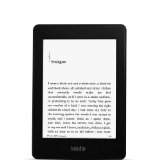
paperwhiteToday’s Kindle deal of the day is a Certified Refurbished Kindle Paperwhite (current generation) with special offers for only $85.00.

My Paperwhite has become my go to ereader. The front lit screen is easy to read on and is a very bright white when compared to the screens of the other Kindles or either one of my Nook e-ink ereaders. It is great for reading in bed without an external light! 🙂

Your Oldest e-book Purchase Date

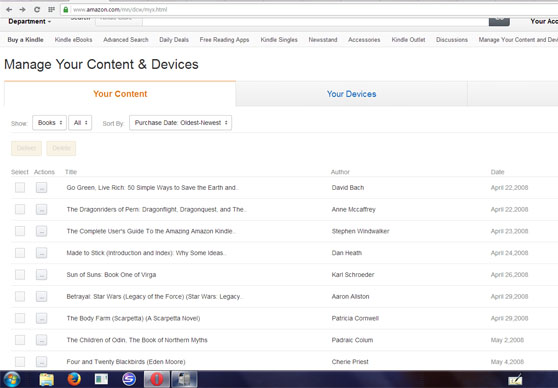
If you own a Kindle  ereader, you have probably noticed that Amazon has completely redesigned the Manage Your Kindle Page (now called Manage Your Content and Devices). If you had a large number of books, the old page was a nightmare to try to use. It showed titles newest first and would only show 10 books or so at a time before you had to go to the next page. And after few pages, the system would time out and you would have to log in again and start all over. It was pretty much impossible to see all your books if you had a large collection. Seeing your oldest e-books was something I never managed to figure out how to do.

myk web page

The new page, however, is quite different to use. While some customers haven’t been wild about the changes, many others enjoy the new feature offered by the redesign. (I personally love it!)  One of the new features is the ability to sort by your oldest books first. There is currently a thread on the KBoards forums discussing this very subject, asking folks to post the date and title of their first Kindle purchase.

My first two purchases on the Kindle were made April 22, 2008.  The first book downloaded was a free one, Go Green, Live Rich: 50 Simple Ways to Save the Earth and Get Rich Trying by David Bach and Hillary Rosner (now $11.64). The first paid purchase was the The Dragonriders of Pern Omnibus  by Anne McCaffrey for $7.96 (now priced at $9.99).

This walk down memory lane was fascinating for me. I can only go back 18 months on my NOOK books. Kobo lists my books, but give little data about them.  The page revealed a lot of interesting data about my e-book buying habits: what I bought and how much I paid for the books. I was buying 7 to 10 books a month for my Kindle, and that doesn’t count the classics I was downloading and reading from Project Gutenberg.

So, how about you? What was your first e-book?

Did You Know: Quick Fix for a Frozen Screen

Here’s a quick fix for when your Kindle is running slow or freezes entirely:

  • Press (or slide) the power button and HOLD for 20 seconds.
  • After 20 seconds, release the power button.  (On the Kindle Fire, press the power button again.)
  • The Kindle start up screen will appear shortly.

Here are more troubleshooting tips,  with pictures, including a nifty timer to count down the seconds to hold down your power button. 🙂


Happy Mother’s Day to my Kindle

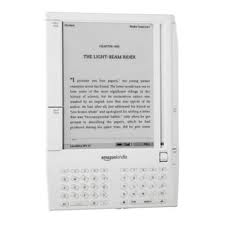
Kindle 1Okay, who is this crazy lady and why is she wishing her Kindle a happy Mother’s Day?

Well, the truth is that for me, the Kindle and Mother’s Day are linked together in my mind. I received my first Kindle, what’s now called the Kindle 1, for Mother’s Day 2008. That makes six years of the magic of reading e-books for me. I still have my original Kindle – and it still works! Since then, I have owned most of the e-ink Kindle models and several Kindle Fires (with a couple of NOOKs thrown in, to boot). At this point, I could not imagine not having an e-reader to read on.

Since I am waxing nostalgic about my Kindles today, I was thrilled to see this article on The Goodereader on The History of the Kindle in Pictures. Take a look; it is a fascinating look at the changes in model styles over the past six years.

Kindles on sale for $49

Basic KindleFor a limited time, Amazon has the basic Wi-fi Kindle with Special Offers  on sale for just $49. The Wi-fi Kindle Paperwhite with Special Offers  is on sale for $99. That’s a savings of $20 off the regular price.The Paperwhite without Special Offers is also on sale.

I own both of these and think that they are great devices. The ads are fairly unobtrusive (I actually like them better than the regular screensavers!). The Paperwhite has become the Kindle I use the most and with the built-in light for reading in bed (especially without disturbing your partner), it can’t be beat.

This is a great entry level price if you are thinking of trying the Kindle or if you want to take advantage of the many free books that are offered exclusively for the Kindle.

What model Kindle do I have?

kindlefireRight when they first came out, I bought one of the original 7″ Kindle Fire Tablets. I use it for games, movies, listening to music and looking up facts on IMDB. While I don’t normally like reading on it (I prefer e-ink), I do find that the full color is great for reading cookbooks.

At Christmas, I received one of the 8.9 Kindle HD Fires as a gift and  now use that one for most of my movies, music and games. But I have reached the point where I own enough Kindle cookbooks  that I am actually considering dedicating my original Kindle Fire for use solely as a cookbook. I actually have so many cookbooks purchased across two Amazon accounts, I am also considering buying another 7″ Kindle Fire to use as a second cookbook for the other account.

Since my intended use for the device is so specific, I don’t necessarily need the latest model, at least not for a cookbook. So, I am trying to decide whether to buy a new one, a certified refurb or a used one. And,  as I am starting to research these options, I realized that trying to compare apples to apples is a little more complicated than I originally thought it would be.

The first difficultly is that people frequently use names for the  Kindles that are not the official Amazon device names.  For a long time, Amazon just called the latest edition of the device just the Kindle (no numbers), as if the earlier versions didn’t exist. Just look at the e-ink line: What many people call the Kindle 3, for example, is now officially called the Kindle Keyboard. And the $69 Kindle is alternately called by most people either the Kindle Basic or the Kindle 4 or Kindle 5 (there are two versions, based on a difference in color).

The model names on the Kindle Fires are especially confusing. Let’s look at just the one I am looking for:  the 7″ tablet. There’s the original Kindle fire,  the new Kindle Fire (which was called the Kindle Fire 2) in either 8GB or 16GB, the Kindle Fire Hd (16GB), the Kindle Fire Hd (32GB), and the 2013 Kindle Fire HD 16GB. There are also four separate versions of the Kindle Fire 8.9! The newer versions of the Kindle HD tablets are now called the HDX. And some devices are WI-FI only and others have cellular.

If you are looking at buying used on ebay, you will see that everybody uses different terms.  Some use terms like “latest generation,” some have model numbers “D01400,” or “3HT7G.”  Some just list 7″ wi-fi, 8GB.” One just said “Dual -core. ” Others list confusing terms like  “Gen 2” and “2011.”

It became really apparent to me that some people might not know exactly what model Kindle they have.

Obviously, I want to know what model I am buying. But even if you are not in the market for a used Kindle, it can be very helpful to know what model Kindle you own. It makes a big difference with support questions; each of the different models works in different ways and has specific features. And if you want to buy a case or accessories, you HAVE to know what model you have; the cases are not interchangeable.

So, how do you find the model for your Kindle? Amazon does have a help page for identifying your Kindle model and that’s a good place to start.

If you are still not sure which one you have, you may need the model number. To find it, from your computer, log in to your Amazon account and under account, choose Manage Your Kindle. On the left sidebar, go down to Your Kindle Account and click on Manage Your Devices.  You will then see all your Kindles and apps listed. The first four characters are your model number.

If you have the original box, the Amazon model number is printed on the box. You can also access the model number from the settings page of the device.

Once you have the model number, you can find out which Kindle or Fire version you have. MobileRead has a chart where you can look up the number and it will tell you which model you have. This chart does not seem to indicate the HDX models.

If  the model number doesn’t help, you may be able to determine which model you have by looking at the feature list. This is particularly helpful on the Kindle Fire HD models, where the 2012 version has a micro HDMI port and the 2013 version doesn’t .  And, if you have the Mayday feature on your Kindle Fire, you have the HDX!

If you still can’t find the model, you can search or post in one of the following message boards:

And if all else fails, you can call Kindle Support at Amazon. (Make sure you call the special support line for the Kindle. The regular Amazon customer service representatives are not trained for technical Kindle questions.)

Managing Your Free Kindle Books, Part Two: Choosing Wisely and Pre-Organizing

This is the second in a three-part series. Part One is here. Most of the information in this series of posts is specific to the Kindle line of e-readers  and the Amazon bookstore.

In Part One, we looked at an overview of some of the problems that can be caused by having too many books on your Kindle or Kindle Fire. The same is true of the Kindle for PC app for your computer or mobile device. While this is just as true for paid books as it is for free ones, the nature of free tends to tempt us to overload our Kindles.

It is also interesting to note that even if a Kindle is not actually malfunctioning due to too many books (freezing, inability to download or highlight,etc.), many people find that as they get more and more books on their Kindles, the device runs much more slowly (slower page turns, slower search, etc.).

So how do we deal with this? The answer is not to avoid free books! There are some great bargains in the free offerings and I have discovered some tremendously gifted authors through their free books, authors such as Hugh Howey, Keith C. Blackmore,and many others.

What we can do is choose more wisely what books to put on our Kindle.  Why is this important? Because the best way to organize is not to put books (paid or free) on the Kindle in the first place that you are ultimately not going to read.  Think of it as pre-organizing and a way cut down on the Kindle clutter.

Keep lists of the books you want to read:  This is as simple and as old-fashioned as it gets. Write down the name of the title and the author. You can make this as low tech (pen and paper) or as high-tech (MS Word, Evernote or even Notepad for the Kindle) as you are comfortable with. Personally, I use Evernote and have a TBR note where I jot down the title and author, a link to a buy page or the review that first caught my eye. That way, I don’t forget about the book, but don’t have to download the sample to remember it. I can then check the book out at my leisure.

Recommendations:  Nowadays, the free books offered on any given day normally number in the hundreds. There are a lot of websites that list free books (EreaderIQ, Kindle Nation Daily, Books on the Knob, Pixel of Ink and many, many others). An internet search for free Kindle books will bring up pages of blogs and curated lists that can help you find books that interest you. Most of these sites give you the ability to search for books in certain categories and genres. Amazon lists the top 100 sellers, both free and paid.

Don’t have time to search through hundreds of free books to find what you like? There are also a lot of places you can get recommendations for free books without having  to sort through the listings. Most genre groups on social networking sites like GoodReads and Shelfari have a place on the message boards that is dedicated to free books of that particular genre.  And if you are looking for a particular author, check their blog, website or Twitter account: Most authors who offer their books for free on the Kindle let their fans know.

Read the reviews:  This is especially important for people who like to find books, then wait to find them free. Good, honest reviews can help you make a decision about whether to download a book or not. Yet, given some of the recent controversies over fake and purchased reviews, it can be difficult to know whether to trust them or not. If you are unsure, click on the reviewer’s name and check out the other ones that they have written.  Look for warning signs: all reviews for the same author, all five-star reviews, or if tis is the only item the person has ever reviewed. Ultimately, remember that reviews are simply the opinion of the person writing the review.

Read the samples: Often, reading the sample of the book can give you a clearer idea about whether you will like the book or not. Do you like the writer’s style and syntax? Are there grammar and spelling errors? The sample can give you an actual feel for the book.

With free books, however, you do not have the opportunity to send a sample to your Kindle or your app.  However, you can still read the sample on your computer by clicking on the Look Inside feature. And, using the feature means that’s one less sample cluttering up your Kindle. Here what it looks like for the The Man Cave Cookbook, which is free periodically.

Click=big

Sometimes, however, samples can cause as many problems as they solve. Some people have pages and pages of samples on their Kindles. Those samples take up space and memory and must be indexed, just like books. In other words, too many samples can cause the same problems as too many actual books!

Fortunately, there are several ways to help organize your samples.  One method is to send all your samples to one place. That can be your Kindle app on your computer or phone. That way, you can read a sample when you have a spare moment to read, but not enough time to get immersed in an entire book. If you have more than one Kindle, you can designate one for all your samples.

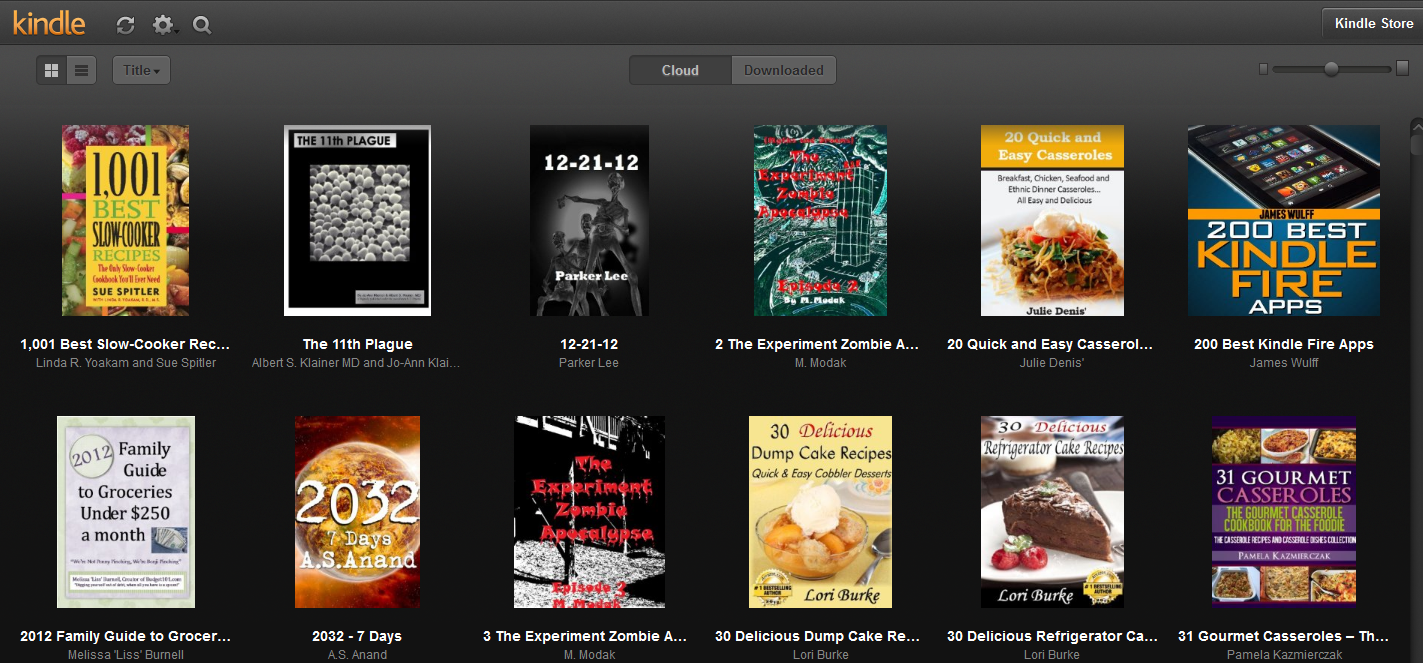
If you want to keep your Kindle totally uncluttered by samples,  you can send them to the Cloud Reader instead of your Kindle. As seen in the picture below, samples on the Cloud Reader show their covers, which can give you a visual jog to help you remember the book.

Click=big

In Part Three, we will discuss organizing your TBR pile, including more ways to organize books you haven’t even downloaded yet. Note: Due to a family emergency, part 3 was never written.

Managing your Free Kindle Books, Part One: The Problem with Free

This is the first in a three-part series. Most of the information in this series of posts is specific to the Kindle line of e-readers  and the Amazon bookstore.

A while back, I did a post on where to find free books for your Kindle. A few more are listed in this article on tips for the new Kindle Owner. When I bought my first Kindle in 2008, free books were very few and generally, offered by major publishers or their imprints. Back then, with few freebies and books going for an average of $9.99,  it made sense to grab every free book that was available. And there were some good ones: I got Tess Gerritsen’s The Surgeon (the first book in the Rizzoli and Isles series) and  Julia Spencer-Fleming’s In the Bleak Midwinter  as just a couple of my early free books.

Now, it’s a different landscape. With Amazon’s KDP Select publishing, literally hundreds of free indie books are offered daily. The number of blogs, websites and newsletters letting you know the daily free books has multiplied exponentially. Even Amazon has made it easy with a list of the top 100 bestsellers, free and paid, on their website.

So now, the TBR pile (your stash of To-Be-Read books) has become a problem of its own.

This is where the difference between digital and physical books becomes quite clear. For a print book reader, the TBR pile was self-limiting. As some point you literally run out of room, your books fall off the nightstand, or the bookshelf simply will not hold anymore.

For book lovers, digital books didn’t have that problem. No cluttered piles of books. Promises of storage for 2000 to 3000 books on your Kindle.  And, with e-readers that had expandable storage options like the first generation Kindle, you could just keep adding more and more books.

Or so it seemed. Try finding a particular book when you can’t exactly remember the name of the title. What happens when you can’t even see all your books in your archives? What happens when your battery won’t last through a book because it is constantly indexing? What if your Kindle starts to malfunction because it is too full? (And yes, that actually happens!)

So now, it seems, the problem has reversed itself: Instead of asking where do I find free books, people are asking where do I find good free books and, more importantly, how do I organize them all? Who would have ever thought that managing free books for the Kindle could actually be considered a problem?

Are you tired of sorting through lists to find free books that are actually worth your time? Maybe you are one of those people who like an uncluttered Kindle home page. Maybe you have so many books on your Kindle that you can’t find or organize them all. Maybe you are tired of books that are badly written, unedited or badly formatted.  Or, perhaps, your Kindle is actually starting to slow down or malfunction because of the sheer volume of books you own.

Over the next few blog entries, we will try to address solutions to some of those problems.

Next time in Part Two: Choosing more wisely and finding sites that will help you do just that.

And in Part Three: Organizing your Digital TBR Pile. Note: Due to a family emergency, part 3 was never written.

Video Review of the new Paperwhite Kindle

Len Edgerly of the Kindle Chronicles just posted a great video review of the new Kindle Paperwhite.  I had initially decided to pass on any of the new Kindles,  but after seeing this, I am reconsidering. My husband inherited my Kindle Touch because I did not like the touch screen at all. This one seems much more responsive, but I am still not sure about no buttons (and no text-to-speech) at all. Take a look:

What do you think after seeing the Paperwhite in action?